Try Sortd for FREETry Sortd
AgentMail raised a $6M seed led by General Catalyst to build email infrastructure for AI agents — programmatic inboxes, provisioned in one API call. Sortd is the other answer to the same question: instead of giving your agent its own inbox on a new domain, give it a supervised seat in your team's real Gmail — with approvals, team handoff, workflow state, and an audit trail already built. This comparison explains when each approach wins, honestly.
Sortd: trusted by 400,000+ professionals · voted #1 for Gmail on Product Hunt · featured in TechCrunch, Forbes and Fast Company · Google Launchpad alumni

| Aspect | Sortd for Agents | AgentMail |
|---|---|---|
| Mail infrastructure | Your existing Gmail / Google Workspace | Their servers; new inboxes & domains provisioned via API |
| Sender identity & reputation | Your real company addresses, with your domain's existing history | New addresses; custom domains require DNS setup and warm-up |
| Setup for agent access | One API key — no Google Cloud project, no OAuth review, no DNS, no billing setup | One API call to create a new inbox (excellent for their model) |
| Human collaboration | Full team UI on the same threads: boards, tasks, assignment, statuses, deadlines, reminders, @mentions, shared inboxes and team chat | None — developer console; oversight is yours to build |
| Approval / safety model | Drafts-for-review by default; graduated send scopes; full audit trail | Developer-defined; no built-in approval workflow |
| Human in the loop and agent → human handoff | Both, as separate mechanisms: drafts-for-review by default, plus escalation onto the assigned team board with the agent's draft attached; the agent resumes afterwards | Not offered |
| Workflow & data | Custom fields (incl. AI-managed), CRM pipelines, SLA rules — agents read and update them | Email primitives (threads, messages, drafts, labels) |
| Connect any agent | Claude, ChatGPT/Codex, Cursor, Claude Managed Agents via MCP + REST | SDKs, MCP, framework integrations — also strong |
| Pricing model | Flat per seat: $10–$29/user/mo annual ($14–$39 monthly). No credits, no per-email fees | Volume-based infra fees ($0–$200+/mo by inboxes + emails) — and the team workspace, approvals and audit UI are yours to build and maintain |
| Track record | A decade of Gmail-native product; 400,000+ professionals | Founded 2024; $6M seed (Mar 2026); strong developer momentum |
| Best at | Supervised email operations on real business mailboxes | Programmatic inboxes at scale; multi-tenant agent platforms |
When an agent emails your customers from a domain registered last month, it starts with no history — which is why agent-first infrastructure requires domain warming and careful volume ramps. On Sortd, the agent works from the Google Workspace accounts and domain your business already operates, inheriting the organisational identity and history you have built for years. Deliverability always depends on sending behaviour, volume and authentication — nobody can promise inbox placement — but starting from your real identity instead of a cold one removes the problem agent-first infrastructure has to engineer around. For customer-facing email, that matters more than anything else on this page.
Every serious deployment of an email agent hits the same moment: the customer replies with something the agent should not handle alone. On AgentMail, what happens next is your engineering problem — you build the review queue, the escalation path, the audit log, the UI your support lead will actually use. On Sortd, that moment is the product: the thread lands on the team board, assigned to a person, with the agent's classification and draft attached; the human approves, edits, or takes over in Gmail; the agent resumes routine follow-up afterwards — and every step is logged. If your agent will ever interact with a customer who can churn, supervision is not overhead. It is the requirement.
These get used interchangeably and they should not be. Human in the loop is a standing condition: the agent never acts unilaterally, because a person reviews and approves before anything reaches a customer. It applies to every message, all the time, whether or not a human ever takes the thread over. Handoff is a discrete event: the agent reaches something it should not settle alone, and ownership passes to a named person who picks it up with the full context and either replies or hands it back. You need both, and each fails without the other. Human in the loop without handoff gives you a review queue nobody owns. Handoff without human in the loop means the agent is already sending, and you find out afterwards.
Sortd implements both, explicitly. Drafts-for-review is the default posture, with graduated send scopes you widen deliberately — that is the loop. Escalation puts the thread on the team board, assigned to a person, with the agent's classification and draft attached, and the agent resumes routine follow-up once they are done — that is the handoff. Every step is logged either way, so the audit trail answers “who approved this” and “who took it over” as separate questions.
Sortd gives your agent the same email primitives an agent-mail platform does — read, draft, send, thread, label, search — through a full REST API and a shipped MCP server. The difference is what sits on top of them. An API on its own produces work that only exists where your engineers can see it. The moment a real business depends on that work, somebody non-technical needs to look at it, and the questions arrive immediately: who owns this one, what is its status, when did we promise a reply, who is covering while Priya is on leave, and why exactly did the agent do that.
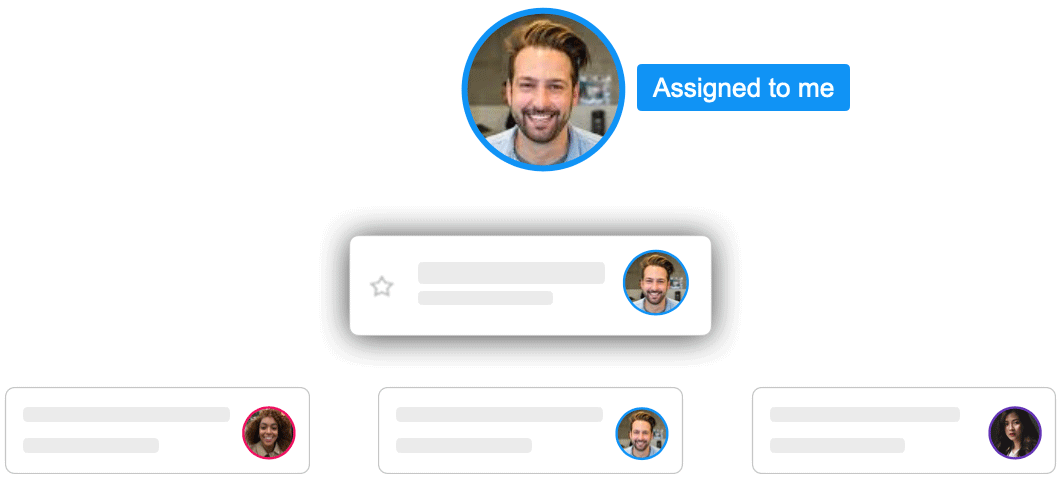
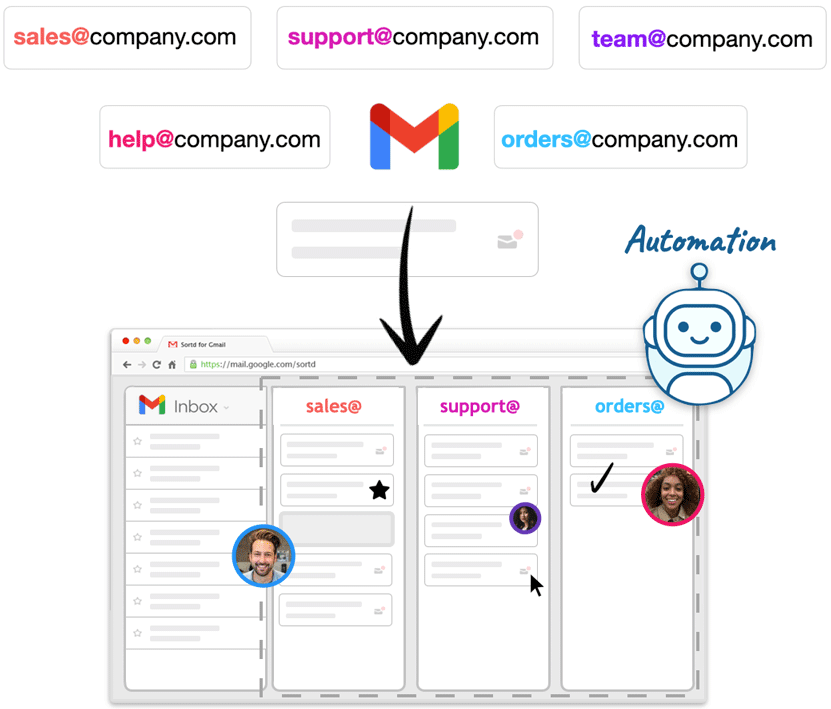
Sortd answers those in the interface your team already lives in. The same threads the agent is working show up on boards, with tasks beside them, assignment and statuses, deadlines and reminders, @mentions to pull a colleague in, custom properties the agent reads and updates, and SLA rules that surface a missed promise before the customer notices it. Because Sortd is native to Gmail and Google Workspace, none of this is a new place to check — it is the inbox your team was already in, with the agent working alongside them rather than somewhere else entirely.
That is the proposition in one line: an API with an interface. Infrastructure your developers can build on, and a workspace the rest of the company can actually use, in the Google Workspace where the work already happens.
This is the difference you feel on day two. With agent-first infrastructure, your agent's work is invisible — a log stream in a developer console. With Sortd, the API comes with something no other agent email solution has: a real interface, native to Gmail. You watch emails and tasks move through your pipeline as the agent works them. You see its drafts waiting for review, its status changes, its field updates. You interact with the agent where you already work — comments, notes, reminders, reassignments — and so does everyone on the team. No new tab, no console, no guessing what the agent did. One workspace for everyone — and every agent.
The alternative to both products is building on the raw Gmail API — which means a Google Cloud project, an OAuth consent screen, restricted-scope review, security assessments, quotas and billing. AgentMail's answer is to sidestep Google entirely with its own infrastructure. Sortd's answer is to carry the Google relationship for you: Sortd is a verified Google Workspace app, so one API key gives your agent a supervised seat on the workspace your team already uses — in minutes, on your real mailboxes.
This is not always either/or. Platforms that provision an inbox for every customer's agent should use AgentMail — that is what it is for. The same company's own support@, orders@ and accounts@ belong in Sortd, where humans and agents share the work. If you have built agent logic on AgentMail, it ports directly: same LLM, same prompts, same knowledge — swap the email tool calls for Sortd's MCP or REST endpoints.
Smart Status auto-tags what needs a response, and AI urgency and sentiment tags watch every shared inbox for risk — included in plan tiers under a fair-use policy, with complaint alerts coming to Business Plus. No credit meters. On Business you can already build your own complaint alerts and routing rules with an AI agent via MCP.
Boards, shared inboxes and assignments in your pocket — triage on the move, hand off from anywhere.
Full API + MCP server so your own agent — Claude, ChatGPT, Cursor, or a hosted Claude Managed Agent — works your team's real Gmail. Drafts-for-review by default, graduated send permissions, flat seat pricing.
Can I use AgentMail for my support@ inbox?
Technically possible via forwarding, but you would be rebuilding team visibility, approvals and handoff yourself. That is the part Sortd ships.
Does Sortd require a Google Cloud project?
No — that is the point. One API key gives your agent a supervised seat on your existing workspace.
Can my agent send from our real domain with Sortd?
Yes, from your existing Google Workspace accounts, under graduated permissions — drafts-only by default, with constrained reply and approved-send scopes you control.
We already built on AgentMail — can we switch?
Your agent logic ports directly: same LLM, same prompts, same knowledge. Swap the email tool calls for Sortd's MCP or REST endpoints.
Which agents work with Sortd?
Any MCP client or REST caller: Claude Desktop, Claude Code, ChatGPT/Codex, Cursor, Copilot, LangChain agents, and cloud-hosted Claude Managed Agents on your own key.
7-day free trial · no credit card · no credit meters
Pricing and features verified July 2026. AgentMail details from agentmail.to and press coverage — always confirm current details on their site. See all comparisons →